Schedule a Free Call

Efficient Spaces Blog

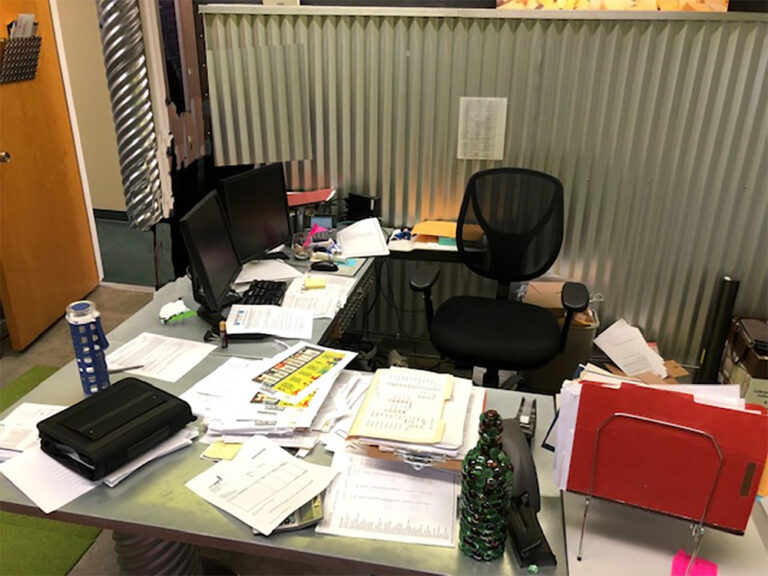
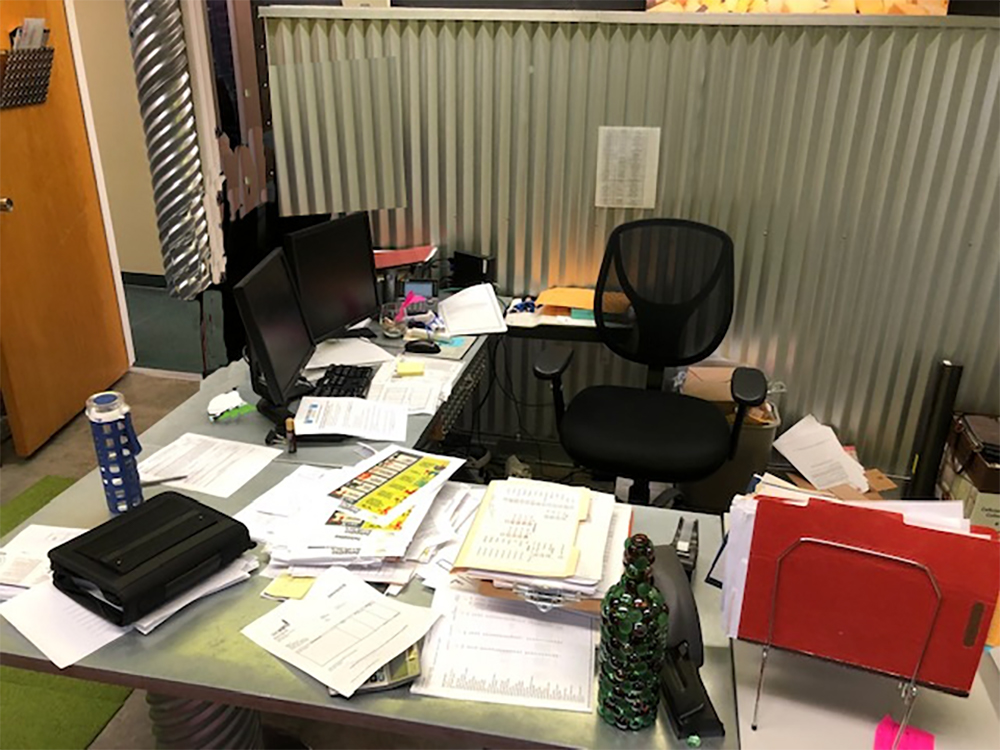
messy, cluttered professional desk

6 Habits Keeping You Disorganized—And How to Fix Them

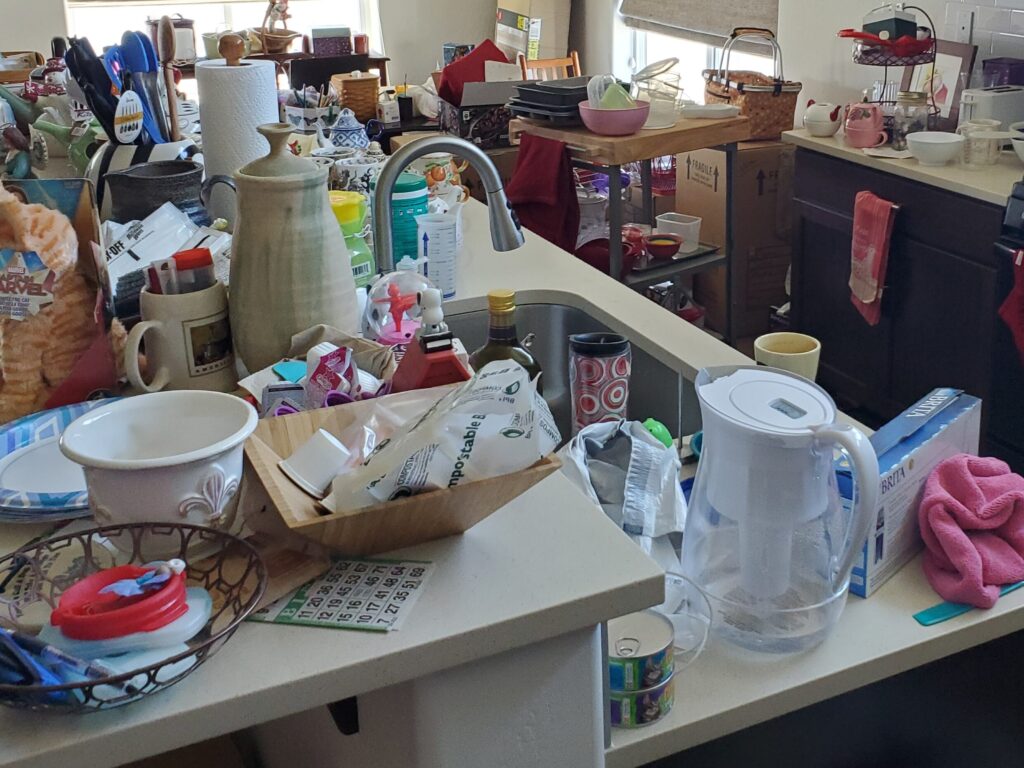
hoarder kitchen messy cluttered

Do you do this? The habit of leaving everything out so you can find it later? Many people make this organizing goof. But the tips in this article will give you some great ideas and propel you to new habits to keep you organized.

Don’t worry, if you put it away, you will be able to find it – whatever it is.

Habit 1

I have no place to put this paper, so I’ll leave it on my desk.

This problem is easily solved. Decide a name that makes sense and make a file for this information, or deal with it (if it’s there as a reminder) by completing the task.

For organized files that are not too cramped, follow these two guidelines:

  • Be careful not to be too specific, or you’ll have files
  • with only one or two pieces of paper.
  • The same goes for file names that are too broad. The goal is to find your docs quickly, so more than 20 pieces of paper for a file hints that it needs to be divided into more specific subcategories. Try putting a few manilla files inside of a hanging file folder to accomplish this.

Habit 2

I leave everything out so I can find it later. I’m afraid if I put it away, I won’t find it again.

You might say, ‘I’m a visual person; I need to leave my stuff out so I can find it!’

It’s pretty obvious why this belief/ habit leads to a messy life. Does this mean all the pots and pans stay on the counter so you can find them? You’ll end up with no counter space to actually make meals.

What about art supplies, will they all be on your easel?  There won’t be enough room to create a piece of art.

For me, saying you’re a visual person is not a reason to leave everything out. I’m a visual person, and I put things away, almost obsessively.

What you’re saying is: I don’t have a system (a consistent ‘home’ for each type of item) for my stuff. So, if I put my headphones in this drawer, I worry I won’t find them again.

When you establish a system, either with my expertise or by doing it yourself, you will have the confidence that when you put items away, you’ll find them again.

We do this by establishing a system that makes sense to you.

And we use labels to mark shelves cabinets, and storage containers.

files

Habit 3

Inconsistent filing

‘I have multiple files for my receipts, paperwork, and even for projects. Sometimes I have to look in four different files for the paperwork I need, and sometimes I cannot find it at all.’

This points to a lack of a system in your filing. Organized files will save you so much time! An inconsistent system or imprecise filing habits can cause delays, inability to find documents, and even panic when you are unable to locate the info you need for a client or determine if you paid a certain bill or a vendor.

Not only that, but gathering info for taxes will be a nightmare.

A system is only as good as the maintenance you put into it!

Jenny Morin

It’s good to be proactive with filing, and to have only one place for each type of document. Decide at the beginning what will go where for organized files.

For example, say you have a very basic filing system, one file for each month, where you put most receipts and payments. Do you put the receipt for a project started in May but finished in June in the May folder or the June folder?

To avoid confusion and wasted time, decide at the outset whether to put receipts for that project in the starting month OR the finishing month. If you tend to forget, you can write it down.

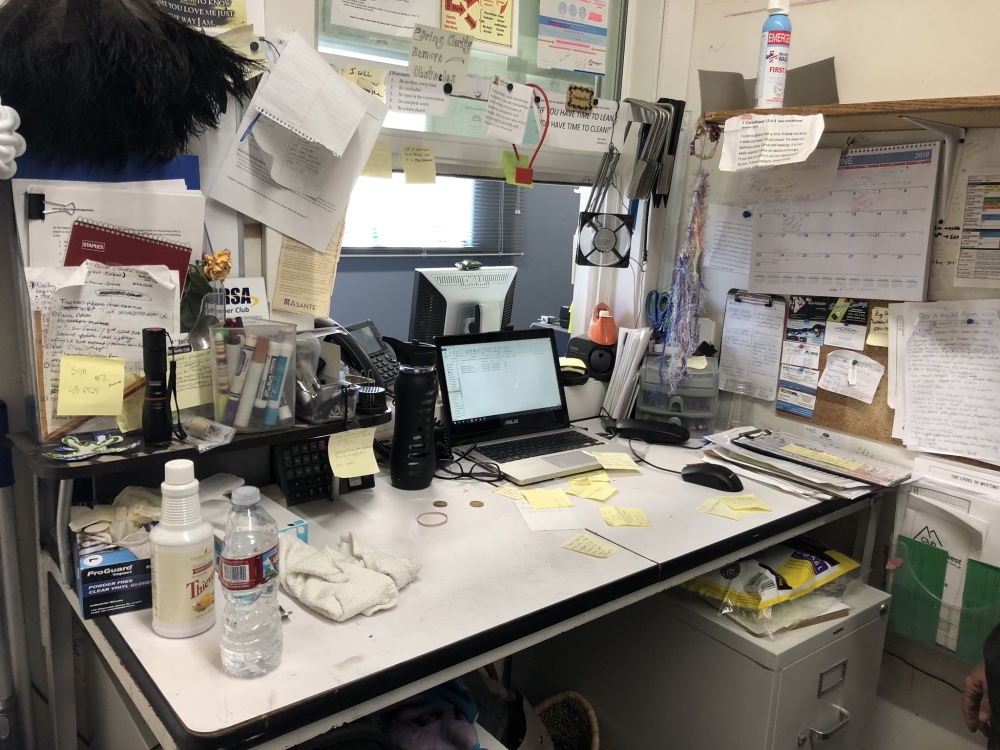
cluttered disorganized shared desk

 A commercial client I work with doesn’t have a consistent habit with his monthly files, so he currently must look in both month’s files to find what he needs. We are working on creating a better system

and filing habits for him. The search for the right receipt becomes more difficult and takes longer when there are 30 sheets of paper in each file.

But won’t I have to go through all my files to fix my filing system? you ask.

Yes, you will. Or you can hire an organizer! If you’re serious about being able to find documents, you’ll have to go through each file and move the ones that need to go into a different file. Organizers call this sorting, and it’s one of the main actions I take when I work with clients to organize files.

Tree in New Zealand in hobbiton

As for not putting off until tomorrow what can be done today:

“The best time to plant a tree was 20 years ago. The second best time is now.”

Chinese Proverb

The same goes for fixing a filing system. If you get motivated to make the fixes to your files, the time spent will pay off in less frustration and less time wasted looking for things in the future!

(This picture is the party tree from Hobbiton in New Zealand.)

Habit 4

‘I put my things in different places every time . . .

Then it takes me forever to find my keys, phone, purse or glasses when I need to leave the house.’

A recent client of mine, who owns a body shop, told me he scatters his tools all over the garage instead of having a ‘home’ for each tool. He realizes looking for tools is a big waste of his time, but he’s always done it this way—it’s his habit. So, we are working on some new habits and a system for his tools.

keys

It’s a sign of chronic disorganization when nothing in the house has a home.

We all lose our keys or phone from time to time, but if you feel your whole life is in chaos, it may be time to hire an organizer to help you create some order. Chronic disorganization doesn’t get better without help.

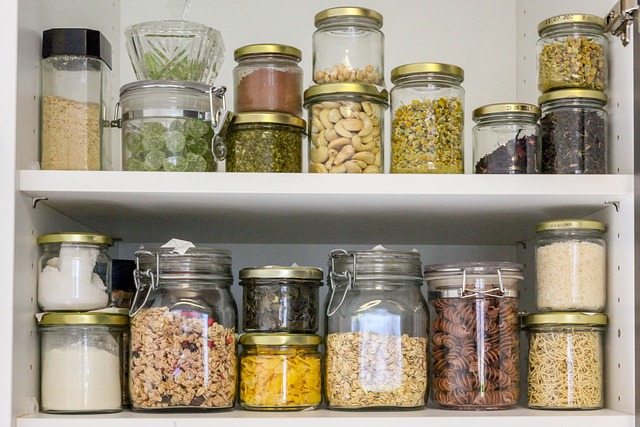
organized pantry

Habit 5

Not taking inventory before going shopping

I don’t know what I have in my:

  • Pantry, so I end up buying way too much of certain foods, then end up throwing away a bunch of expired food every year.
  • Garage, so I end up buying duplicate fertilizer, painting supplies, garden tools, mechanical tools, etc.
  • Office supply closet, so I buy way too much paper & Post-its, and sometimes run out of envelopes or other needed items.

It’s a great idea to take stock of what you have before you buy anything. I’ve had organizing clients who regularly go grocery shopping without checking what’s in their pantry first, then end up with food spoilage.

Years ago, I volunteered to clean out the supply closet for our Josephine County public library. Some of the paper & supplies were over 20 years old! We sorted all the like items together, labeled the shelves, and threw out the obsolete items. Once we were done the librarian told us she would save money on supplies since now she knew exactly what was in there.

Habit 6

Buying duplicates

‘I can’t find my ____________ when I need it, so I end up buying another one.’

Many times, this situation happens with tools in the garage or the shop. I had a friend in a networking group, a hoarder, who told me his basement was so clogged that he ended up buying a second table saw rather than excavate the table saw he already owned from the mess.

I am happy to say, he courageously cleared out his basement, bit by bit, and can find his tools now. He proudly showed me pictures of his progress.


To Conclude

I hope I’ve dispelled the myth that if you’re a visual person, you need to leave everything out to find it later. Visual clutter creates a low level of stress in our bodies; it is not good for us.

Another good habit to cultivate is to create organized files that make sense and consistently put documents away.

Being consistent is a big part of staying organized.

A system is only as good as the maintenance you put into it!

In other words, I can organize your office down to the last paper clip, but if you don’t put things away, you’ll soon find yourself in a mess again.

I hope the tips and stories in this article will help you get motivated to organize those little and big spaces in your life!

multi tasking woman

5 Tips to keep Distractions at bay

You turn on your home computer to send an email that needs to go out this morning to your PTA or Rotary group.  But before you click “write” you notice a Pinterest notification; a friend re-pinned one of your pins. Curious, you click on it. That leads you down the rabbit hole and you are lost in the attractive and addictive world of Pinterest.  Before you know it, you’ve wasted 30 minutes and still haven’t sent out the essential email!  You have to leave for work in half an hour, so you probably will miss breakfast . . . again.

This is the anatomy of a typical distraction.

Funny thing . . . as I went to the internet to find a dynamite quote about distractions, guess which site came up?  PINTEREST!  I admit it, I did get on Pinterest, but I only allowed myself 10 minutes to search.

One way to boost our will power and focus is to manage our distractions instead of letting them manage us.

Daniel Goleman

I like to call distractions ‘bright and shiny things,’ which take you away from your goal.

Distractions are a part of life, something to either get over or give in to.  Stay focused, or give in to the bright and shiny things.

How can you keep distractions from derailing your day?

To help withstand distractions, it helps to know your goal.  Use it to stay focused.

5 Ways to Keep Distractions at Bay

  1.  Identify what a real emergency is.   Sometimes at work, you will get a red-flagged email that says it’s an emergency; it needs your attention NOW.  Is that really true? If it’s from your manager or boss, yes it does. But how about other requests?  Know your company’s policy.
  2.  Have a plan.  When you are tempted to just check that one text that came through, but you are supposed to be drafting the agenda for this afternoon’s meeting, have a plan. This could include turning off your personal notifications during work hours, silencing your cellphone during focus time, or just training yourself to wait until you finish your current task.
  1. If you are frequently interrupted during the day, and you are blocking off time to complete focused, high-concentration work, leave some room in your schedule.   If it’s going to happen, make it part of your plan so you don’t get frustrated.  I call this leaving ‘white space’ in your calendar.
  1. Change your physical environment.  Studies show that those in cubicles are interrupted 9 percent more than those with an enclosed office (Real Simple, Dec. 2014).  If it’s possible to rearrange your work environment, take advantage of that. For example, facing away from the cubicle opening. However, many people cannot. It’s also quite helpful to use sound-canceling headphones to block distracting noise.  
  1. Kick the urgency addiction.  How often do you check your phone for texts?  How often do you check your email?  Is the newest thing on your plate the most attractive for you to work on?  Can you go a whole day without getting on Facebook, Pinterest or Twitter?  Try it.  You might learn something about yourself.

Distractions are a part of life, something to either get over or give in to.  It is a choice.  The choice is yours to make!

Resources:

Stay healthy at your desk with 3 cubicle tweaks:

www.pinterest.com/explore/distraction-quotes/http://www.brainyquote.com/quotes/keywords/distractions.html#BozKhmVjdLjKzZ0i.99

Real Simple magazine, Dec. 2014.

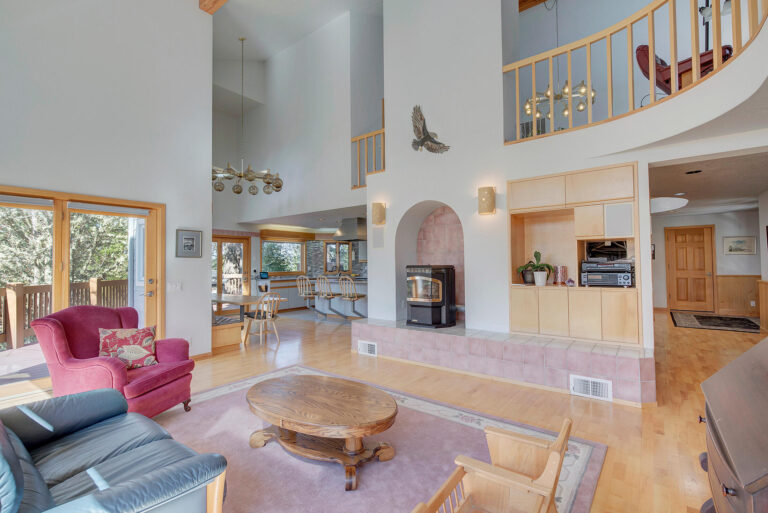
Bright living room with fireplace

Decluttering Living Room Tips Featured in Redfin Blog

One of my tips for decluttering living rooms is featured in the Redfin blog! 19 Must-Read Storage Hacks for a Cluttered Home. You’ll find my insights in Tip 17: Involve Your Family.

And here are some EXTRA tips to keep your living room looking neat!

1. The Clutter Buster

Here’s one creative idea I used in my family of 4 children. When the house started looking cluttered—which it often did—I would warn them ahead of time that we’d be doing a cleanup and give them some transition time. Then we started a 10 to 15-minute clutter buster. I asked everyone to stop what they were doing, pick up 10 things and put them away. It’s amazing how much better your house looks when 40 items of clutter get picked up! You can also use a timer so it’s a race against the clock.

2. Maintaining a tidy living room

In the living room especially, blankets, magazines, electronics (and cords) and gaming devices become an issue. One thing that bothers me is how messy the blankets look when strewn haphazardly over the couches.

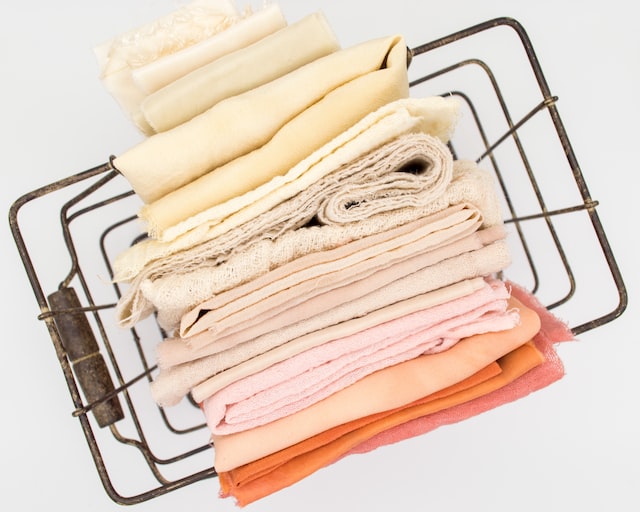
An easy solution for a tidy living room is to get a large, attractive basket, then fold & put away the blankets every night. That way, at least the living room stays neat all day, until family time the next evening! It takes regular decluttering to keep up with the chaos.

3. Cords, Cords, Cords!

Cords are such an eyesore. I especially detest black cords cluttering my living room. So, I went to an organizing store and bought a small grey bin that fits a power strip, and a couple game controllers with room for coiled up cords. It works well and looks MUCH better.

Another solution is to get a cord “tube” (it looks like an old-fashioned spiral telephone cord) and channel all your cords through it. They come in a variety of colors, and you can hide them along the baseboard or under the couch. This is a great help in decluttering your living room and making it feel more orderly.

The Redfin blog has a lot of other great tips (besides my own), so I hope you find something that will help you work through your current organizational challenge! And don’t forget to check out my other blogs, which cover topics from holiday shopping to food storage strategies. You’ll find them all on my website, efficientspaces.org.

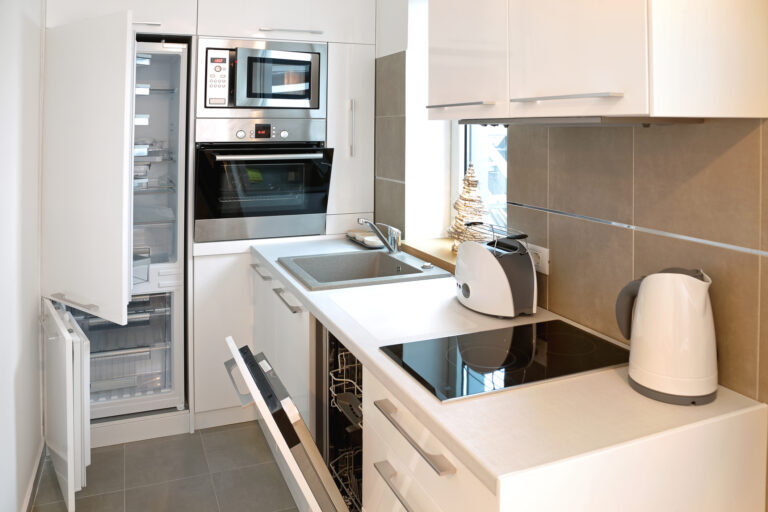
Organized Tiny kitchen

Space-saving Ideas for Tiny Kitchens: Say Goodbye to Frustration

Ideas for RVs, apartments, and tiny houses

I’ve been taking some trips in my RV lately, traveling for about a week at a time for Comicons with my husband, a writer. I like traveling! I especially love setting up and organizing a new kitchen with space-saving gadgets. It makes our life on the road easier!

It will make your life easier, too, if you have a small kitchen.

I have some ideas to help you enjoy your small space to the maximum!

Our RV is a forest River Nitro, and one reason we chose this one is the kitchen design. Some RV kitchens have a narrow ‘galley’ kitchen created by the island or peninsula, but we like this open L-shaped footprint for the kitchen cabinets.

To me, the kitchen feels more open this way. The only real disadvantage to this kitchen is the depth of the drawers, which are only 9 ½ deep! I had to improvise because a normal silverware organizer will not fit in my kitchen drawer. I’m sure there are things about your kitchen or apartment that require creative solutions. Read on for some great storage ideas!

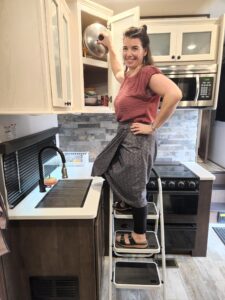
But the kitchen in my RV has plenty of storage for food, dishes, pots and pans, etc., as long as you’re willing to get on a stepladder to get to the 2nd shelf.

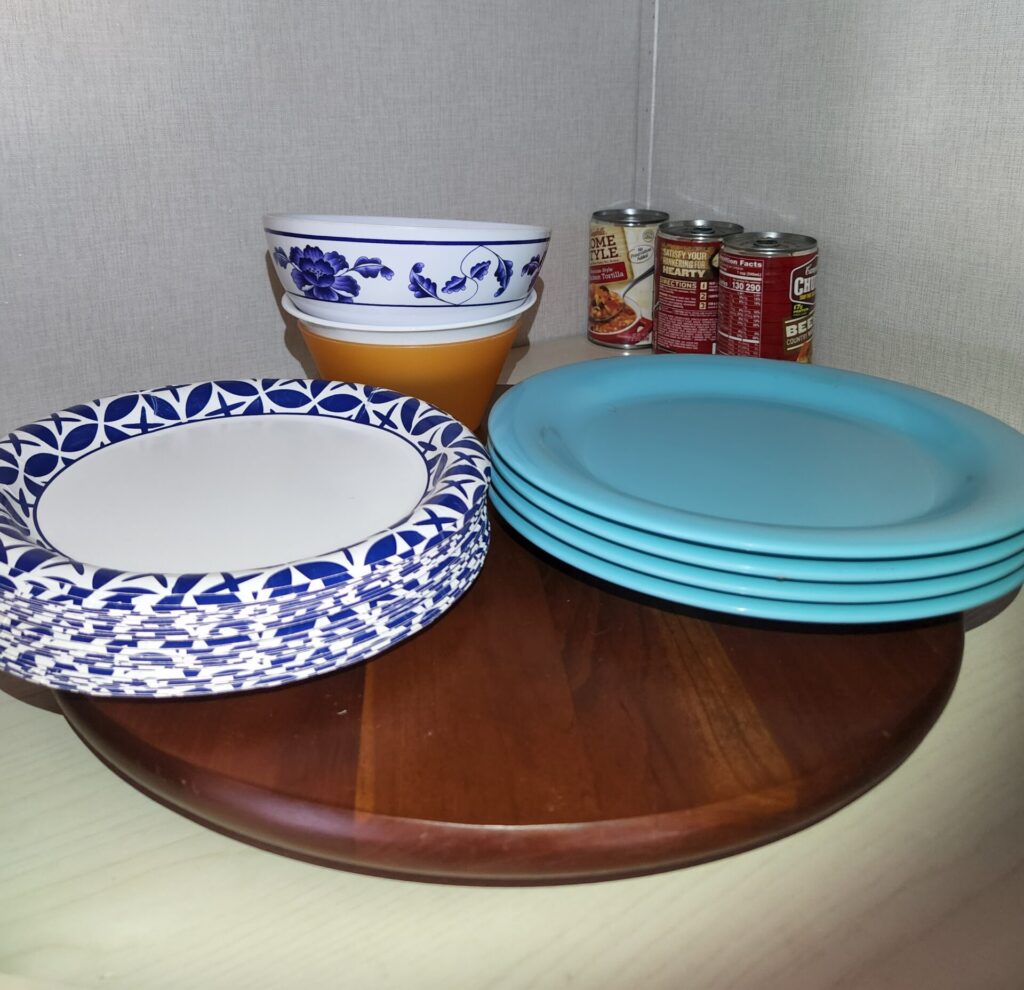
One way I solved the problem of not being able to reach the back of the cabinet is by adding a large lazy susan. It almost fills the space and allows me to reach three sets of dishes without going on tiptoe. That made it so much more convenient!

The Look Up Principle. A storage idea if you don’t have enough space: whenever this happens look UP to find more space. And by this, I mean: look at your blank walls and even the space above your cabinets. These can be used for seldom-used items like a punch bowl or large vases.

A good general organizing rule-of-thumb is: if you use an item often, it needs to be closer to the hub of action. If you use it infrequently, it can be stored farther away from the action, even in a garage, basement, or attic. Just make sure to label it so you can find it when you need it!

To create a storage system for a kitchen, I always take a look at what I have for cabinets, then figure out a general idea for where to put things. Sometimes that plan is based on the size and shape of the cabinet.

Then I measure each drawer dimensions, including vertical space. I measure each cabinet too. Then I think about what kind of —– I can add to make my space as efficient as possible. To store as much food or kitchen tools as possible.

Either taking a short video or some photos helps with this planning process. Or if you’re really into it, make a sketch of your kitchen and label the drawers and cabinets with the dimensions.

Space-saving Idea 1: Use a lazy Susan for awkward areas

For example, I have a large corner cabinet which is very deep. I can’t reach all the way to the back without climbing on the counter or getting on a stepstool. As I mentioned before, I solved that by adding a large 18-inch lazy Susan, and by putting things in the ‘way’ back that I don’t need to access often (I put some canned food there). By the way, I put bowls, plates, and paper plates on the lazy Susan.

Space-saving Idea 2: Create a shelf

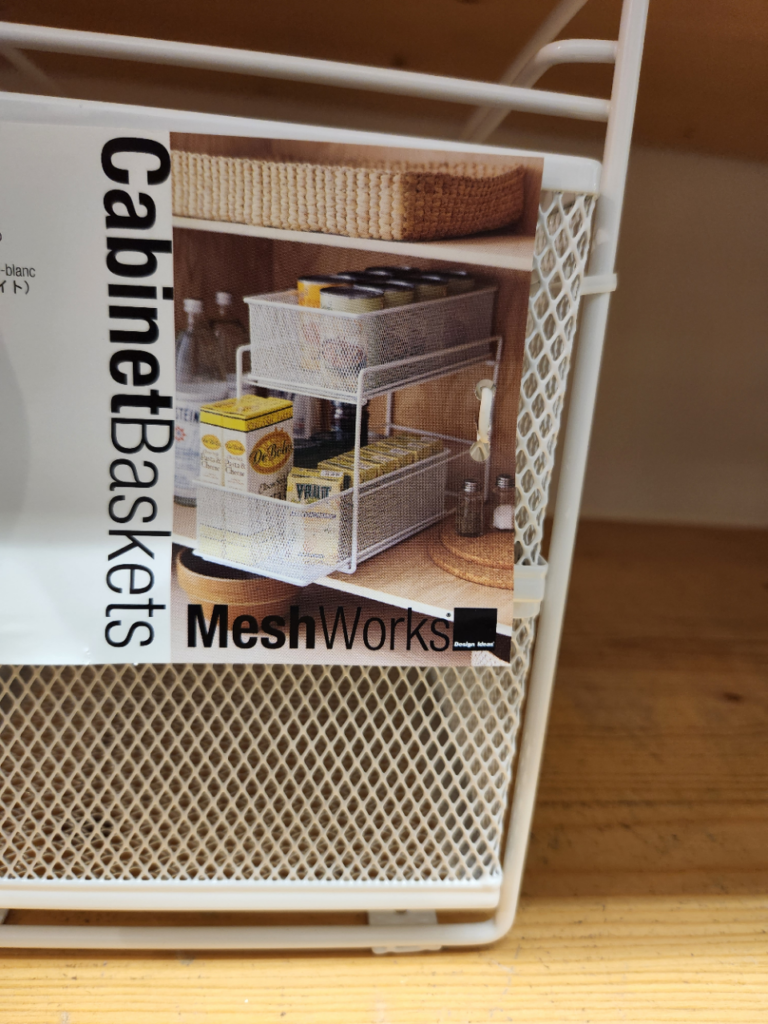
One thing I noticed right away in the camper: there is too much vertical space between the kitchen shelves. And the shelves are not adjustable. My solution for this dilemma is to create a shelf using a wire cabinet shelf. They can hold a surprising amount of weight, and I usually opt for the ones that can stretch to be multiple lengths. Mine stretches from 14 inches to 24 inches long if needed. These are available at organization stores or some big box stores.

Space-saving Idea 3: Maximize counter space

If you like a clear counter, you’re going to have to work hard to get it in a small kitchen. One way I do this: hang stuff up instead of using your ‘prime real estate’ counter space. This is part of the Look Up Principle. When you need more storage, look up.

  • Under-cabinet paper towel holders keep paper towels off counter.
  • Try a ‘hammock’ for bananas, they won’t get bruised in transport! This genius idea was already installed in my former camper. Its just 2 hooks, a dowel with grooves at the end to hold the hammock, and a cute hammock made of string that attaches to the dowel with 2 loops.
  • Place a small catchall basket to containerize the little things. My basket usually holds a sleeve of crackers, flashlight, small tools, and tea bags. This keeps clutter contained and keeps emergency supplies handy should the power go out. This basket has to be regularly unloaded and we are careful not to let the amount of stuff expand and become clutter the kitchen countertop.
  • Use 3M hooks on the wall above the counter for small, light things you use frequently, like potholders.

Think double-decker. I have used two-tiered storage under sinks and on counters before. They come in a few different sizes, and most of them slide in & out. Many of them are intended for the fridge, but would work great on a small kitchen counter (or inside a skinny cabinet). Most of them have a chrome framework and 2 plastic drawers. Some are about the size of a dozen eggs, and other units are bigger. It’s a bonus if you can find some with clear or opaque drawers.

Space-saving Idea 4: Clear boxes

Just ask my kids, I love boxes. I especially love clear boxes because they allow you to see what’s inside. You almost don’t need to label them . . . almost. 😉

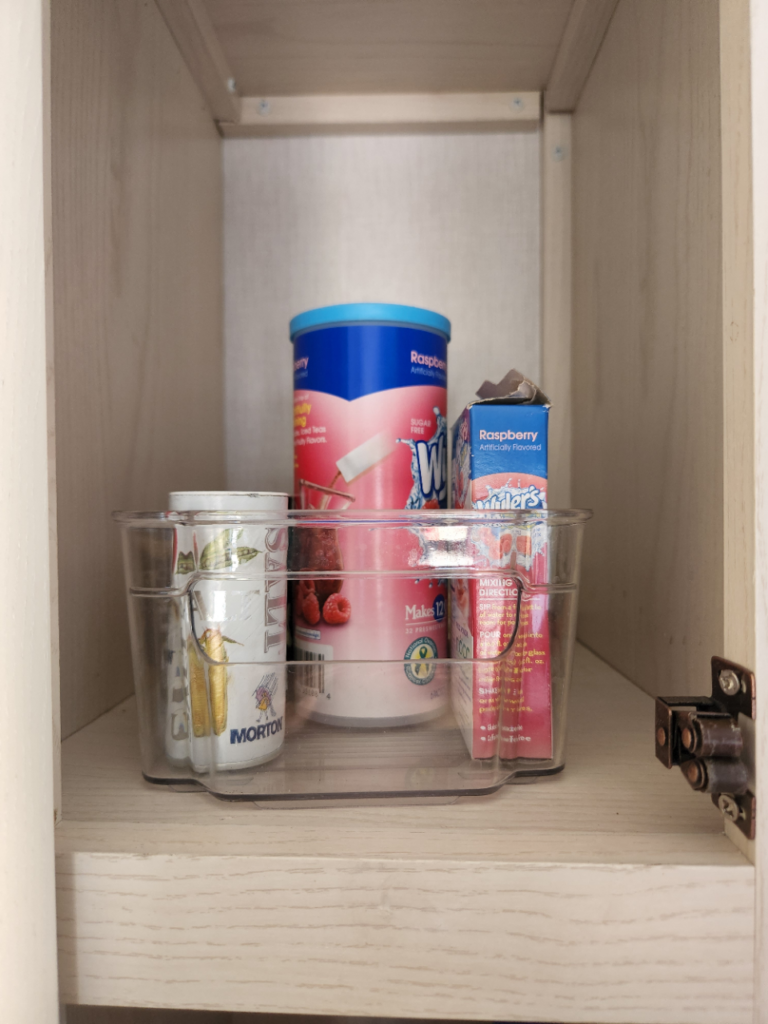
I have 2 very thin cabinets that aren’t a very useful size. They’re about 8 inches wide each, and again, the vertical distance between shelves is HUGE. The upper shelf is so tall I can only reach the very front of it on tiptoe.

To solve this storage problem, I use 2 narrow clear open-topped boxes. One on the lower shelf and one on the upper shelf. This enables me to easily grab the clear box from the top shelf, retrieve something I need, and put it back.

Clear boxes are a great idea for just about everything! you almost don’t need a label.

. . . ALMOST!

Safety Tip: Make sure the one on the high shelf contains things that are light enough for you to easily lift above your head. Canned soup is NOT a good idea, in case one falls on your head while you’re tipping the container to lower it!

Helpful Shopping Hint

Many times, Ross or TJ Maxx will have great prices on organizing products. The only downside is they have a lot of ‘orphans,’ so if you want all your organizing products to match, pick a color or theme and buy only those. (I haven’t found matching containers all at once, I end up piecing my collection together over time.)

I opt for clear or white to have a more uniform look. But your style might be retro colors or black and chrome. Pick a style or color that makes you happy!

Conclusion

With small-space living, in a small apartment, tiny house, or RV, it is especially important to have a plan because space is at such a premium. Don’t just throw a bunch of random stuff in a cabinet and expect it to work. Take time to analyze your space and use it intentionally. Your space will seem bigger when you are organized and things are put away. This will keep you from feeling claustrophobic in your own home

You’ll be much happier with the design and more comfortable too!

1 2 3 4 8 9
Privacy Settings
We use cookies to enhance your experience while using our website. If you are using our Services via a browser you can restrict, block or remove cookies through your web browser settings. We also use content and scripts from third parties that may use tracking technologies. You can selectively provide your consent below to allow such third party embeds. For complete information about the cookies we use, data we collect and how we process them, please check our Privacy Policy
Youtube
Consent to display content from - Youtube
Vimeo
Consent to display content from - Vimeo
Google Maps
Consent to display content from - Google
Spotify
Consent to display content from - Spotify
Sound Cloud
Consent to display content from - Sound
Schedule a Free Call